
Tyler New World Power BI dashboards for police and sheriff's offices
The build reads the export or read-only view your Tyler New World or Enterprise Public Safety system already produces, so a different records system changes the field names, not the work. What comes out is a monthly crime, calls for service and case report in Power BI that refreshes on a schedule, so the first of the month stops being a deadline.
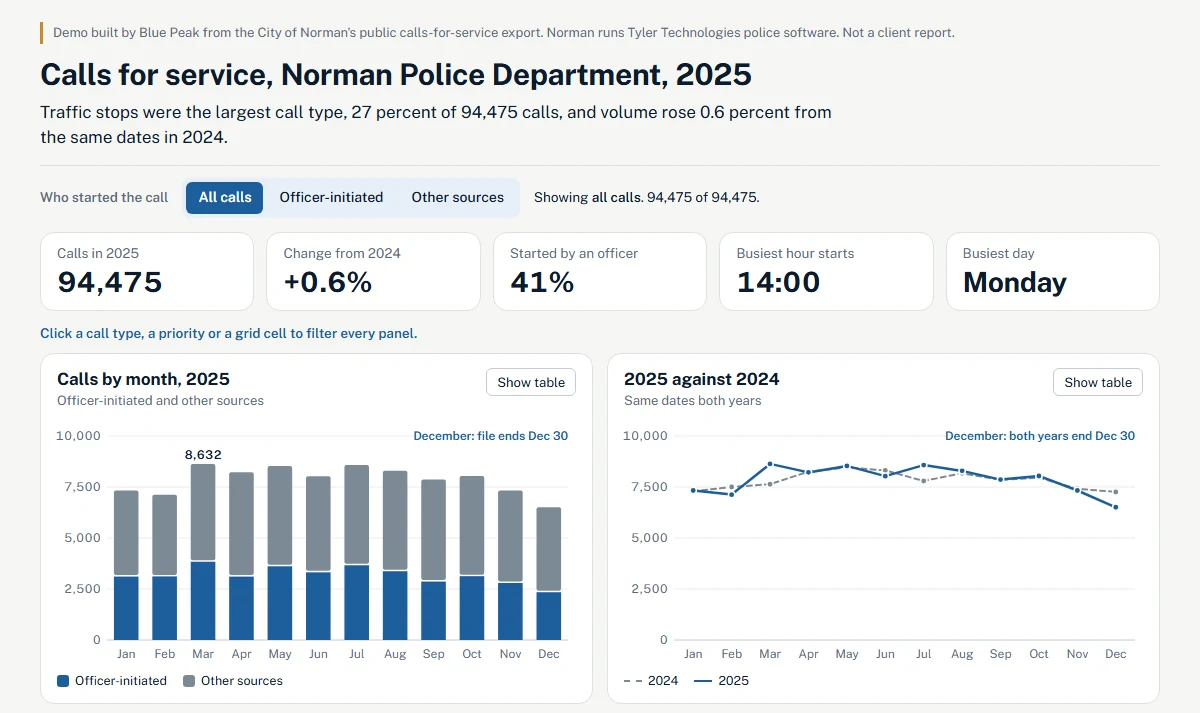
What the monthly report covers
The pages command staff, a city manager or a county commission ask for every month. The counts come from your Tyler data and the layout follows the monthly report you already send.
- Crime. This month, last month, the same month last year and year to date, grouped the way your state NIBRS file is grouped, so the report and the file you submit agree.
- Calls for service. Calls by hour, day of week, beat and priority, with response time from call received to first unit on scene shown as a median and a spread.
- Cases. Cases by status, how long open cases have been open, and clearance by offense type, so what is stuck shows without anyone pulling a list.
- Monthly command staff packet. The same layout every month, refreshed on a schedule, then emailed by the Power BI service or exported to PDF for the council packet; the council version is on the monthly police report page.
From the export we ask for the incident or case number, the offense or NIBRS code, the report date and time, the location or beat, the call received, dispatched and on-scene times, the call nature and priority, and the case status and cleared date, whatever your system calls them.
Which Tyler system do you run?
Tyler Technologies sells its public safety software as Enterprise Public Safety. Its records brochure prints Enterprise Law Enforcement Records powered by New World, so you will see both names.
- New World and Enterprise Public Safety. The suite for police and sheriff's offices under its old and new names. Tell us which name is on your contract and which modules you run.
- Records Pro. A separate Tyler records product. The same question applies: how does your analyst get data out today?
- Citations and jail. Tyler's citation tools, Brazos and Enforcement Mobile, and its jail system, Enterprise Corrections, hold their own data. A monthly report can draw on them as a second export.
For all of them the question is the one we answered at Riley County: how does the data come out? A scheduled export, a report the system already produces, or a reporting database your IT can point an ODBC or SQL connection at. Any of the three is enough for a build.
How a build runs
The same four steps on every Blue Peak project. Your agency keeps control of the data at every one of them.
- Your staff set up the data path. Your IT staff, or your vendor's support desk, set up whichever is easiest: a scheduled export, a report the system already produces, or, where your agency has a reporting database and the vendor allows it, a read-only ODBC or SQL connection. We do not need a login to your live system to start, and on a first project we usually do not ask for one.
- We read the export and write down what it means. We list the fields, ask about every ambiguous one, and write down what each means in your agency: what counts as a call, when a case counts as cleared, which offenses roll up to which category. If your analyst already has reports in Crystal Reports or SQL Server Reporting Services, we start from those, because they show which numbers you trust.
- We build it in your tenant, or host it. The report is built and published in your own Microsoft tenant, with no annual license from us and no seat count. If you would rather not publish and maintain it, we host it through Blue Peak Dashboards as one flat monthly subscription, and the hosted pages carry counts and figures you clear for it. Records with names, plates or case narratives stay in your own systems.
- You get the template. You get the Power BI template and the .pbix file, the documentation, and a working session with whoever will maintain it, so your analyst can refresh and change the report without calling us. If you never call again, it keeps running.
Where the proof comes from
Blue Peak is building a Power BI report set for the Riley County Police Department in Manhattan, Kansas, on the department's Spillman Flex system. The connection is a read-only ODBC link to the Flex database that RCPD's own staff set up. The report pages cover crime statistics, calls for service, maps, investigations and case tracking. It ships as a Power BI template that RCPD opens and refreshes inside its own environment.
The Johns Creek and Norman demos were built from public exports with no agency involvement.
More on police work: Power BI dashboards for police departments, the public safety demo built from records the Olathe Police Department publishes, and the pages for CentralSquare and Omnigo.
If you are changing records systems
Agencies change records systems, and a dashboard that breaks on cutover day is a bad trade. We build so that what counts as a call, a crime or a cleared case is defined once in the data model, not on each report page. When the source changes, the source step is redone and the definitions are rechecked against the new export, and the report pages stay.
That is how the build is designed to work. We would check every definition against the new export, field by field, rather than assume it carried over. If your cutover date is close, say so in your first note and the written scope will name which system the report reads.
Questions
Which records systems have you built on?
Our first production build is on Spillman Flex. Yours would read your Tyler export the same way; the Norman demo on this page was built from the calls-for-service export Norman publishes, and Norman runs Tyler Technologies police software.
Is New World the same as Enterprise Public Safety?
Tyler Technologies now sells it as Enterprise Public Safety, and its records brochure prints Enterprise Law Enforcement Records powered by New World, so you will see both names. Tell us which one your agency uses and which modules, such as records, dispatch, jail or citations. The report is built from whatever your analyst can export from them.
Our analyst builds reports in Crystal Reports or SQL Server Reporting Services. Does that help?
Yes. Those reports show which numbers your agency trusts and how each is counted, so they are the specification for the first Power BI pages. We build to match them and check the totals against them before you rely on the new report.
Can Power BI connect straight to Tyler, and do we have to give you access?
Sometimes it can connect, and when it cannot, an export does the job. Power BI reads anything with an ODBC or SQL connection, which is how the Spillman Flex build works. We do not need a login to your live system, and on a first project we usually do not ask for one. Your staff produce the export and choose what is in it. Your IT staff, or your vendor's support desk, can usually tell you in one email which options you have.
We are changing records systems. Is it worth building now?
It depends on the date. The definitions live in the data model, so a new source means redoing the source step and rechecking the definitions, not rebuilding the pages. If the cutover is close, we would build against the system you are moving to and say so in the written scope.
How long does it take, and what does it cost?
Three to eight weeks for a first dashboard, from the day we have your export in hand. The clock is usually set by how quickly your IT can produce a clean export, not by the build. It is quoted in writing from a written scope. A build in your own tenant carries no annual license fee from us and no seat count. If we host the dashboards for you, that is one flat monthly subscription, quoted with the build.
Where does our data live, and who owns the dashboard?
On a standard build it stays in your environment: reports are built and published in your own Microsoft tenant and never copied to a Blue Peak server. If we host the dashboards, the hosted pages carry counts and figures you clear for it, and records with names, plates or case narratives stay in your own systems. The .pbix file, the data model and the documentation are yours either way.
Tyler Technologies, New World, Enterprise Public Safety, Enterprise Law Enforcement Records, Records Pro, Brazos, Enforcement Mobile, Enterprise Corrections, Crystal Reports, Spillman Flex and the other product and program names on this page are trademarks of their owners. Blue Peak Data Consulting is an independent firm and is not affiliated with or endorsed by any of them.
Free first page
Send one month of your export and we build the first page at no cost. If it does not match your own counts, you owe nothing and keep the file.
Blue Peak Data Consulting, Olathe, Kansas. Police departments and sheriff's offices in Kansas, Missouri and across the country.
(913) 777-4770 · sergei@bluepeakdataconsulting.com